Chapter 11: Governance, Compliance, and Evidence Pack
Governance in MLSecOps
Governance means that decisions related to the model, data, risk, and release are explainable, traceable, and auditable. In AI systems, the absence of governance prevents teams from explaining how a model was built, why it was released, and what should be investigated in a security incident.
References / Source mapping
Frameworks and standards - NIST AI RMF: Govern - ISO/IEC 42001: AI management system - OWASP AI Exchange: Governance controls
Shadow AI governance
Shadow AI is the use of AI tools (ChatGPT, Claude, Copilot, browser extensions, personal API keys, embedded SaaS AI features) without IT/security approval, monitoring, or contractual coverage. It is distinct from shadow IT: the risk is not only unauthorized infrastructure but data in prompts, unaudited model outputs, and supply-chain features inside approved SaaS (Notion AI, Slack AI, M365 Copilot on personal seats).
Field reality: Industry surveys report high employee AI adoption with low formal AI security policy coverage (e.g., Salesforce workforce AI surveys cited in 2025–2026 governance literature). Treat shadow AI as a governance + data-exfiltration problem, not a blocking-only problem.
Why shadow AI matters for MLSecOps
| Risk | Example | Framework mapping |
|---|---|---|
| Regulated data in consumer LLM | PII/PHI/source code pasted into personal ChatGPT | GDPR, HIPAA, EU AI Act literacy (Art. 4) |
| No DPA / vendor review | Consumer-tier tool processes customer data | SOC 2 CC9, ISO 42001 supplier control |
| Unmonitored agent plugins | IDE extension calls external model with repo context | OWASP LLM03 supply chain, LLM02 disclosure |
| Personal API keys in code | Developer key in notebook touching prod data | Ch.6 control point 3 secrets review + shadow key discovery |
| Embedded AI in sanctioned SaaS | Copilot on personal M365 vs corporate tenant | CASB/SSPM gap — traffic looks "approved" |
Documented pattern: Samsung restricted generative AI tools after internal data was pasted into ChatGPT (2023). See Chapter 13 — Shadow LLM usage.
Shadow AI vs sanctioned MLSecOps path
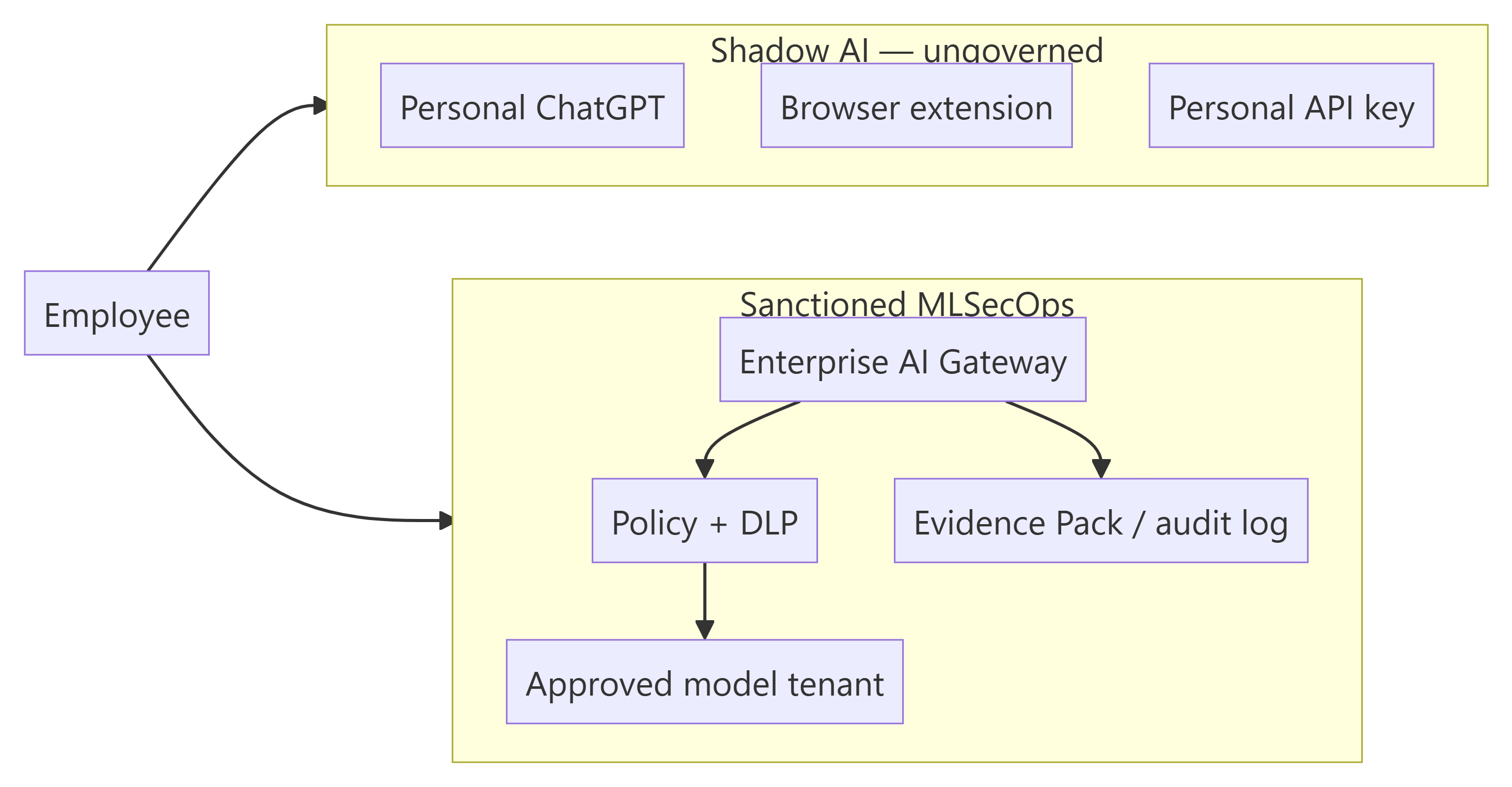
MLSecOps lifecycle controls (Ch.6) do not protect data sent to shadow tools. Shadow AI controls are parallel: discovery, acceptable use policy, enterprise gateway, and DLP.
Five-layer detection stack
Based on enterprise governance patterns (CTAIO Shadow AI guide, systemprompt.io governance guide, Proofpoint shadow AI reference):
| Layer | What it catches | Tooling examples |
|---|---|---|
| L1 — Network / CASB | Traffic to api.openai.com, Claude, Gemini, etc.; corporate vs personal OAuth tenant |
Netskope, Zscaler, Prisma Access, Cloudflare SWG |
| L2 — SaaS / SSPM | AI features inside approved apps (Notion AI, Slack AI, Salesforce Einstein) | CASB, SSPM (Obsidian, Valence, etc.) |
| L3 — Endpoint / browser | Extensions, desktop apps, clipboard → AI upload | EDR, browser extension inventory, endpoint DLP |
| L4 — Developer environment | Personal Copilot seats, API keys in IDE, .env with OPENAI_API_KEY |
Gitleaks, secret scan (Ch.12), internal dev survey |
| L5 — AI gateway (sanctioned path) | All approved traffic with prompt logging, PII scrub, budget | LiteLLM, Kong AI Gateway, ToTra, ThinkWatch, internal gateway (Ch.7) |
Gap to document explicitly: L1–L3 rarely cover 100% of shadow usage (personal devices, embedded SaaS AI, offline local models). Residual risk should be accepted only with sanctioned alternatives and executive acknowledgment.
AI Acceptable Use Policy (AI-AUP) — minimum contents
| Section | Requirement |
|---|---|
| Approved tools | Named list (e.g., ChatGPT Enterprise, Claude for Work, internal RAG) with owners |
| Prohibited data classes | Regulated PII/PHI, credentials, unreleased source, customer contracts in consumer-tier tools |
| Account type | Corporate tenant / SSO only for work-related AI; personal accounts discouraged or blocked on corp devices |
| Approval process | Fast-track request for new tools (reduces bypass motivation) |
| Incident reporting | How to report accidental paste/leak |
| Training | EU AI Act Art. 4 AI literacy where applicable |
Publish AI-AUP before wide blocking — bans without alternatives typically increase underground usage (systemprompt.io).
30-day shadow AI rollout (operational)
| Week | Activity |
|---|---|
| 1 — Discover | Inventory from CASB/SWG/IdP logs; developer survey; extension audit; map personal vs corporate OAuth |
| 2 — Classify | Risk-tier each tool (public LLM, IDE plugin, embedded SaaS AI, local model) |
| 3 — Enable | Launch sanctioned enterprise AI + gateway; SSO; DPA/sub-processor review for regulated data |
| 4 — Enforce | SWG allow/warn/block; DLP in monitor mode first, then block for highest-sensitivity classes; tune false positives |
Technical controls (map to MLSecOps)
| Control | Shadow AI mitigation | Guide reference |
|---|---|---|
| Enterprise AI gateway | Route all approved LLM/API traffic; log prompts; kill switch | Ch.7 gateway, Ch.10 telemetry |
| Presidio / DLP at gateway | Block/mask PII before outbound prompt | Ch.4, Ch.12 |
| SSO + corporate tenant only | Block personal ChatGPT on corp network where policy allows | Governance + IT identity |
| Secret scanning | Find OPENAI_API_KEY, Anthropic keys in repos |
Ch.6 control point 3, Ch.12 Gitleaks |
| Centralized API proxy | Developers use org proxy, not raw provider keys | Ch.5 key management |
| SIEM correlation | Alert on bulk uploads to AI domains | Ch.10 |
Open-source gateway references (sanctioned path)
The projects below are non-endorsed examples of open-source gateway patterns. Validate maturity, licensing, and operational fit before use.
| Project | Role in shadow AI reduction |
|---|---|
| LiteLLM | Self-hosted proxy; virtual keys; team budgets; 100+ providers |
| Kong AI Gateway | Enterprise API management + AI plugins on existing Kong |
| ToTra | Go gateway; PII blocking; quota; audit log |
| ThinkWatch | Enterprise AI bastion; MCP + API proxy; RBAC; audit |
Providing a sanctioned, productive alternative reduces shadow demand more than blocking alone (CTAIO AI security stack).
Evidence Pack fields for shadow AI program
| Field | Example |
|---|---|
shadow_ai.inventory_date |
2026-06-01 |
shadow_ai.tools_discovered |
12 unsanctioned destinations |
shadow_ai.sanctioned_gateway |
LiteLLM prod URL |
shadow_ai.dlp_mode |
monitor → enforce schedule |
shadow_ai.ai_aup_version |
v1.2 |
shadow_ai.residual_risk_accepted |
personal mobile — documented exception |
Anti-patterns
| Anti-pattern | Consequence | Alternative |
|---|---|---|
| Blanket ban without enterprise AI | Underground usage increases | Sanctioned ChatGPT Enterprise / internal RAG + gateway |
| DLP block-only on day one | Workarounds (mobile hotspot, personal laptop) | Monitor → tune → enforce high-sensitivity only |
| Ignoring embedded SaaS AI | "Approved" Notion/Slack with ungoverned AI feature | SSPM + feature-level policy |
| No personal vs corporate account distinction | OAuth to personal Google/OpenAI | CASB tenant enforcement |
| Shadow AI excluded from threat model | Lifecycle controls give false confidence because unapproved tools bypass them | Include Shadow AI row in Ch.2 attack surface; govern in Ch.11 |
References / Source mapping
Frameworks and standards
- EU AI Act: Art. 4 AI literacy (where applicable)
- OWASP LLM Top 10: LLM02, LLM03 (shadow data path)
- MITRE ATLAS: AML.T0057 LLM Data Leakage; AML.T0110 AI Agent Tool Poisoning (ungoverned MCP / IDE plugins)
Implementation guidance (this guide) - AI system inventory (Chapter 2); MCP security (Chapter 7)
Author practical guidance - 30-day rollout and gateway vendor lists are operational patterns, not standards.
OpenSSF MLSecOps Mapping (Whitepaper 2025)
Affiliation: This guide is not published or endorsed by OpenSSF. The table below maps the OpenSSF Secure MLOps whitepaper lifecycle stages and security measures to chapters in this community reference. Use the OpenSSF document as the authoritative source for their architecture; use this guide for lifecycle decision and evidence patterns.
| # | OpenSSF lifecycle stage | OpenSSF security measures (summary) | This guide — chapter / artifact |
|---|---|---|---|
| 1 | Planning and design | Threat modeling, secure design, SBOM visibility | Ch. 2, 6 (prerequisite); Ch. 5 (AI-BOM) |
| 2 | Data engineering | Validation, versioning, lineage, anomaly detection, encryption | Ch. 4; control point 4 |
| 3 | Experimentation | Supply chain security, poisoned data detection, experiment tracking | Ch. 4, 6 (stages 2–5) |
| 4 | ML pipeline dev & test | Reproducibility, secure artifact validation, pipeline testing | Ch. 6 (control points 3, 7) |
| 5 | Continuous integration | SAST/SCA, policy enforcement, dependency scan | Ch. 6 (control point 3); Ch. 12 |
| 6 | Continuous deployment | Secure deploy automation, artifact checks, trusted packages | Ch. 6 (control points 8–10); signing |
| 7 | Continuous training | Drift detection, re-validation, authenticated feedback data | Ch. 6 (CT cycle) |
| 8 | Model serving | Input validation, access control, output filtering | Ch. 7, 8; runtime gateway |
| 9 | Continuous monitoring | Drift, anomaly, alerting, adversarial monitoring | Ch. 10; SOC |
| — | Cross-cutting (OpenSSF tools) | Sigstore, SLSA, Scorecard, GUAC | Ch. 5, 12 |
| — | Cross-cutting (DevOps) | Secrets, IaC scan, CI attestation | Ch. 6 control point 3; Ch. 12 |
| — | Evidence | Audit trail of which measures are implemented | Evidence Pack (this guide) |
The organization's Evidence Pack should record which OpenSSF-aligned measures—plus LLM/RAG/agent controls from OWASP and ATLAS—are implemented for each deployment, aligned with the threat model.
References / Source mapping
Frameworks and standards - OpenSSF MLSecOps whitepaper (2025): lifecycle stages and security measures in table above - NIST AI RMF: Map / Govern across lifecycle
Implementation guidance (this guide) - Lifecycle control points (Chapter 6); Evidence Pack
Optional assurance tiering — illustrative only
Non-standard concept: The tiering below is an optional organizational planning aid. It is not an OWASP, ISO, EU, or industry standard. For formal compliance, use
ISO/IEC 42001,ISO/IEC 23894, theEU AI Act, and the organization's legal/compliance process.
| Level | Example context | Minimum evidence expectations |
|---|---|---|
| Tier 1 | Internal low-impact assistants | Basic threat model, artifact review where applicable, runtime logging |
| Tier 2 | Customer-facing LLM/RAG services | Lifecycle decision evidence, red team suite, signed or tamper-evident evidence bundle |
| Tier 3 | High-risk domains (medical, finance, critical infrastructure) | Independent security review, continuous monitoring, formal risk register, human oversight |
References / Source mapping
Frameworks and standards - ISO/IEC 42001; ISO/IEC 23894; EU AI Act — formal compliance frameworks cited in section note - NIST AI RMF: risk-based assurance tiers (conceptual alignment)
Author practical guidance - Tier 1–3 table is an optional organizational planning aid, not an OWASP, ISO, EU, or industry standard.
STRIDE and FMEA applied to ML assets
The methods below apply established threat-modeling techniques to ML/AI assets. They are not separate published standards:
| Method | Application |
|---|---|
STRIDE-AI |
Mapping threats to ML assets (data, model, API) |
FMEA-AI |
Assessing fairness impact and algorithmic harm with Failure Mode and Effects Analysis |
Color Teams |
Combining red/blue/purple team for the ML development cycle |
References / Source mapping
Frameworks and standards - OWASP AI Exchange: Threat modeling decision tree - ISO/IEC 23894: AI risk assessment methods (FMEA adjacency)
Implementation guidance (this guide) - Threat model template (Appendix E.3); Chapter 2 threat modeling (Chapter 2)
Author practical guidance - STRIDE-AI and FMEA-AI labels apply established techniques to ML assets; not separate published standards.
Reference frameworks
| Framework | Application |
|---|---|
NIST AI RMF |
Risk management for AI systems |
ISO/IEC 42001 |
AI management system |
ISO/IEC 23894 |
AI risk management |
OWASP LLM Top 10 |
Threats to language models (2025 edition, stabilized) |
OWASP ML Top 10 |
Threats to ML models (still draft) |
OWASP LLMSVS |
Verification standard for LLMs (structured testing and evaluation) |
MITRE ATLAS |
Modeling attack techniques against AI |
EU AI Act |
Legal requirements based on risk level |
References / Source mapping
Frameworks and standards - Sources listed in table above; OWASP AI Exchange: Governance controls
Implementation guidance (this guide) - Traceability convention (Chapter 15)
What is an Evidence Pack?
An Evidence Pack is a bundle of technical and managerial evidence showing how an AI system, model, RAG index, agent configuration, or managed AI service configuration was built, evaluated, controlled, and released. It is an audit evidence pattern, not a mandatory OWASP file format. Organizations may implement it as signed JSON, a document bundle, a GRC record, an artifact registry entry, or another tamper-evident evidence mechanism.
References / Source mapping
Frameworks and standards - NIST AI RMF: Govern / Measure (documentation and monitoring evidence) - ISO/IEC 42001: documented information for AI management system
Implementation guidance (this guide) - Appendix E.4 — Evidence Pack template
Author practical guidance - Evidence Pack field names and structure are community implementation guidance, not a published OWASP or ISO file format.
Recommended Evidence Pack contents
| Section | Evidence |
|---|---|
| Data | Data origin, version, owner, sensitivity level, scan results |
| Model | Version, parameters, metrics, hash, signature |
| Security | Results of adversarial, backdoor, and prompt injection tests |
| Supply chain | SBOM, AI-BOM, vulnerabilities, provenance |
| Policy | Gate decisions, policies, approvals |
| Deployment | Environment version, configuration, release method, rollback plan |
| Runtime | Telemetry, alerts, guardrail decisions |
References / Source mapping
Frameworks and standards - NIST AI RMF: Govern / Measure (documentation evidence) - EU AI Act: Art. 11 technical documentation; Art. 12 record-keeping (high-risk adjacency) - ISO/IEC 42001: documented information requirements
Implementation guidance (this guide) - Evidence Pack components; Appendix E.4 — Evidence Pack template
Evidence Pack components
| Component | Content | Application |
|---|---|---|
| Model identity | hash, version, source, and build date | Tracking in incidents and rollback |
| Supply chain | SBOM/AI-BOM, SLSA, in-toto, and provenance |
Supply chain audit |
| Integrity | Digital signature with Cosign/Sigstore and verify result where artifacts are controlled; managed-service configuration snapshot where model weights are provider-managed |
Preventing artifact substitution or unreviewed configuration drift |
| Security testing | Reports from ModelScan, ART, prompt injection, and poisoning |
Demonstrating due diligence |
| policy | Quality decision log, OPA/Conftest, exceptions, and approver |
Transparency of Go/No-Go decisions |
| runtime | Telemetry, alerts, and prompt trace in incidents | Incident response and postmortem |
References / Source mapping
Frameworks and standards
- OpenSSF MLSecOps whitepaper (2025): SBOM, signing, provenance (Sigstore, SLSA themes)
- OWASP LLM Top 10 (2025): LLM03 supply chain; OWASP ML Top 10 (draft): ML06
Implementation guidance (this guide) - SBOM and AI-BOM (Chapter 5); Release decision model (Chapter 6)
Relationship to compliance
| Framework | Relationship to Evidence Pack |
|---|---|
NIST AI RMF / ISO 42001 |
The Evidence Pack is the operational output of the govern and map sections and shows that controls are actually implemented. |
EU AI Act |
For high-risk systems, documentation of data, post-deployment monitoring, and incident recording are fed from evidence and SOC telemetry. |
ISO/IEC 23894 |
Risks in the risk register must trace to threat mapping, production checklist, and auditable controls. |
Practical mapping of EU AI Act requirements (High-Risk systems) to controls
| EU AI Act requirement | Related control in this guide |
|---|---|
Risk Management System (Art. 9) |
Risk management + versioned threat model (Chapter 2) |
Data Governance (Art. 10) |
Data control, lineage, PII masking (Chapter 4) |
Technical Documentation (Art. 11) |
Evidence Pack and AI-BOM (Chapters 5, 11) |
Record-Keeping / Logging (Art. 12) |
Telemetry, prompt/tool logging (Chapter 10) |
Transparency (Art. 13) |
Model documentation, provenance, user-facing instructions (watermarking only where legally required for specific AI outputs) |
Human Oversight (Art. 14) |
HITL and Intent Gate (Chapter 8) |
Accuracy, Robustness, Cybersecurity (Art. 15) |
Adversarial testing, signing, runtime guardrail (Chapters 5, 6, 7) |
Post-Market Monitoring (Art. 72) |
Runtime monitoring and SOC (Chapter 10) |
This mapping shows how MLSecOps technical controls may support documentation and audit activities relevant to the EU AI Act—provided that evidence is maintained automatically, reviewed by legal/compliance teams, and adapted to each deployment context.
References / Source mapping
Frameworks and standards - EU AI Act: articles cited in tables above - NIST AI RMF; ISO/IEC 42001; ISO/IEC 23894
Implementation guidance (this guide) - Evidence Pack components
Mapping EU AI Act requirements to Evidence Pack components
The table below shows which section of the Evidence Pack (Chapter 11) and what evidence should cover each legal requirement for high-risk systems:
| EU AI Act requirement | Evidence Pack component | Expected evidence |
|---|---|---|
Risk Management System (Art. 9) |
policy + threat model | Versioned threat model document, risk register, gate decisions |
Data Governance (Art. 10) |
Data | Lineage, data contract, PII scan report, dataset version |
Technical Documentation (Art. 11) |
Full bundle | Signed Evidence Pack for each deploy |
Record-Keeping / Logging (Art. 12) |
runtime + policy | Prompt/tool/retrieval log, retention policy, gate audit log |
Transparency (Art. 13) |
Model identity + supply chain | Provenance, AI-BOM, model documentation, deploy instructions (watermark if legally required) |
Human Oversight (Art. 14) |
policy + runtime | HITL log, human approval runbook, kill switch |
Accuracy, Robustness, Cybersecurity (Art. 15) |
Security testing + integrity | ART/red team report, ASR relative to baseline, signature and verify |
Post-Market Monitoring (Art. 72) |
runtime | Telemetry, SOC alerts, drift report, postmortem |
This mapping is technical guidance, not legal advice. Final interpretation of
EU AI Actrequirements rests with the organization's legal and compliance teams.
Policy-as-Code
Security policies should not remain only in documents. Where practical, they should be applied in executable form in release workflows and at runtime. Tools such as OPA, Conftest, or an internal policy engine can perform this work, but the control objective is policy enforcement and auditable decision-making—not any specific tool.
Example policies:
- A model without a signature is not allowed to be released.
- Data with unmasked
PIIis not allowed for training. - A critical vulnerability in dependencies causes the build to stop.
- An
LLMmodel without prompt injection testing is not allowed to deploy. - An agent without an
Intent Gateis not allowed to invoke sensitive tools.
References / Source mapping
Frameworks and standards - ISO/IEC 42001: operational control and policy enforcement - OWASP AI Exchange: Governance controls - OpenSSF MLSecOps whitepaper (2025): CI/CD policy enforcement themes
Implementation guidance (this guide) - Lifecycle control points 4, 8 (Chapter 6); Policy examples in Chapter 12
Responsibilities
| Role | Responsibility |
|---|---|
| Model owner | Defining purpose, acceptance criteria, and business risk |
| ML team | Training, evaluation, and version recording |
| Security team | Threat model, security testing, and policies |
| Platform team | Infrastructure, access, monitoring, and deployment |
| Governance team | Compliance, audit, and evidence management |
References / Source mapping
Frameworks and standards - NIST AI RMF: Govern (roles and accountability) - ISO/IEC 42001: roles, responsibilities, and authorities (management system) - OWASP AI Exchange: How to organize AI security (GUARD)
Implementation guidance (this guide) - Personas and shared responsibility; Release decision model (Chapter 6)
Personas and shared responsibility
| Persona | Security focus | Area of responsibility |
|---|---|---|
Solution / ML Architect |
Secure architecture and service boundary | Introduction, lifecycle controls, and MLOps alignment |
MLOps / AI Engineer |
Release workflow, deploy, and CT | Lifecycle controls and tools |
Data Scientist / Engineer |
Data quality and experimentation | Data and experimentation |
Data Governance |
PII, compliance, and lineage |
Data and compliance |
Product Security |
Threat model, release decisions, and assurance | Threats and lifecycle controls |
SOC / IR |
Runtime, alerts, and incident evidence | SOC and evidence pack |
References / Source mapping
Frameworks and standards - OWASP AI Exchange: How to organize AI security (GUARD) - Cloud provider shared-responsibility models (managed AI services)
Implementation guidance (this guide) - Responsibilities; Reading paths
Tamper-evident storage
Minimum practical steps for evidence retention:
- Store the
Evidence PackinS3or equivalent withObject Lock. - Sign each bundle with
Cosignand verify before deploy. - Separate write access from read access; audits should be read-only only.
- In a
P1incident, store an immediate snapshot in a separate bucket with lock.
For organizations with strict audit requirements, an advanced option is to use Rekor Transparency Log or a hash chain in the manifest.
References / Source mapping
Frameworks and standards - OpenSSF: Sigstore / Rekor transparency log practices - EU AI Act: Art. 12 record-keeping integrity (high-risk adjacency) - ISO/IEC 42001: control of documented information
Implementation guidance (this guide) - Model signing (Chapter 5); Evidence Pack
Security validation and assurance
A control without measurement of effectiveness is only a checkbox. The assurance loop must show that gates are actually effective and that deploy decisions are made based on numeric criteria.

| Stage | Output | Owner |
|---|---|---|
Test Harness |
Versioned suite in Git | Security + MLOps |
| Security validation | Metric report and suite hash | MLOps |
| Deploy decision | pass/fail relative to baseline | Model Owner |
| Production | Telemetry and feedback related to FP/FN | SOC |
| CT / retrain | Full suite regression | MLOps |
References / Source mapping
Frameworks and standards - NIST AI RMF: Measure / Manage (validation and monitoring) - OWASP AI Exchange: Continuous validation; OWASP LLMSVS
Implementation guidance (this guide) - Red Team program and security test cadence (Chapter 6); Verification vs. validation
Assurance metrics
Example thresholds only — each organization must set acceptance criteria in its threat model and policy.
| Control | Metric | Example acceptance | Frequency |
|---|---|---|---|
Policy-as-Code |
Violation detection rate in red team | 100% on critical rules | Every release |
LLM Gateway |
False negative on injection suite | Maximum 5% critical prompts | Monthly and after tune |
LLM Gateway |
False positive on benign suite | Maximum 2% | Monthly |
ART |
ASR @ epsilon |
Maximum baseline + 2% | Every new model |
RAG Ingest |
Poison doc retrieval rate | Zero percent in regression set | Every index change |
Agent Output Gate |
Bypass in output-injection cases | Zero critical | Every agent release |
References / Source mapping
Frameworks and standards - OWASP LLMSVS: structured testing and evaluation thresholds - NIST AI RMF: Measure (control effectiveness)
Implementation guidance (this guide) - Security validation and assurance; Governance Benchmark Suite
Author practical guidance - Example acceptance thresholds are illustrative; each organization must set criteria in its threat model and policy.
Optional regression scoring pattern — illustrative only
Non-standard concept: The formula below is an optional internal planning aid, not a published metric and not an OWASP standard. Do not use it as a compliance score, public maturity claim, or cross-organization benchmark. Weights (
w1–w3) must be defined per organization; metrics are not directly comparable without normalization.
For decision-making, a conceptual score can be defined:
score = w1 * clean_metric + w2 * (1 - ASR_or_bypass_rate) + w3 * gate_pass_rate
One possible internal decision rule is:
score(new) >= score(baseline_signed) - delta
The value of delta should be set in the organization's threat model. This example should not replace explicit release criteria for critical controls.
References / Source mapping
Frameworks and standards - NIST AI RMF: Measure (quantitative risk assessment — conceptual alignment) - ISO/IEC 23894: risk treatment and acceptance criteria
Author practical guidance - Regression scoring formula and weights are an optional internal planning aid, not a published metric or OWASP standard.
Governance Benchmark Suite
For assurance to be repeatable, the security benchmark must be versioned and traceable:
- Maintain the test suite in the repository with a tag such as
security-suite-v1.x. - Any change to a gate or guardrail triggers re-running the suite in CI.
- Record results in the
Evidence Packalong with suite hash, execution date, and model version. - A false negative—an attack that should have been blocked but passed through—should be tracked as an incident or defect with higher severity than a false positive.
References / Source mapping
Frameworks and standards - OWASP AI Exchange: Continuous validation; AI security testing overview - OpenSSF MLSecOps whitepaper (2025): reproducible security testing themes
Implementation guidance (this guide) - Red Team program and security test cadence (Chapter 6); Evidence Pack
Verification vs. validation
| Axis | Verification |
Validation |
|---|---|---|
| Question | Is the control implemented correctly? | Is the model or system sufficient for production? |
| Example | OPA rule deployed and gateway is in the traffic path | ASR, bypass rate, and accuracy are acceptable |
| Location | Infrastructure audit and production checklist | Security validation and Canary |
Maturity level 2 means a stable gate and suite exist. Maturity level 3 means automated regression score and false negative error tracking in the SOC are in place.
References / Source mapping
Frameworks and standards - ISO/IEC 42001: verification and validation themes (management system) - NIST AI RMF: Measure (testing vs. operational adequacy)
Implementation guidance (this guide) - Maturity roadmap (Chapter 14); Assurance metrics
Vulnerability disclosure and external intelligence sources
MLSecOps governance should not be internal-only. The organization must define a path for receiving and publishing model/AI infrastructure vulnerabilities:
| Source / mechanism | Application |
|---|---|
huntr (huntr.com) |
Dedicated AI/ML bug bounty platform for receiving vulnerability reports |
AI Vulnerability Database (AVID) |
Database of known model vulnerabilities |
AI Incident Database |
Lessons learned from real AI incidents |
MITRE ATLAS |
Updates to attacker tactics/techniques |
Internal Coordinated Vulnerability Disclosure |
Formal path for reporting vulnerabilities in the organization's models |
Recommendation: Define a security.txt or CVD process for the organization's AI models and APIs, and feed these sources back periodically into the threat model (Chapter 2) and test suite (Chapter 6).
References / Source mapping
Frameworks and standards - MITRE ATLAS: tactic/technique updates — https://atlas.mitre.org/ - OpenSSF: coordinated vulnerability disclosure practices - OWASP AI Exchange: AI program / inventory
Implementation guidance (this guide) - Threat model (Chapter 2); Red Team program (Chapter 6)
Practical principle
If a model is not auditable, it is not trustworthy from an organizational perspective. Evidence must be produced concurrently with building and releasing the model—not after an incident and not manually.
References / Source mapping
Frameworks and standards - ISO/IEC 42001; EU AI Act high-risk documentation themes (see Relationship to compliance)
Implementation guidance (this guide) - Release decision model (Chapter 6)