Appendix E: Implementation Reference
Purpose: Operational artifacts for teams implementing MLSecOps in production. This appendix is not production code or vendor-specific IaC. It complements the reference chapters with architecture cards, decision matrices, fill-in templates, playbooks, and a master control matrix.
Relationship to other appendices: Appendix A/B summarize threat and ATLAS mappings; Appendix D covers managed AI checklists. This appendix ties them to your architecture choice.
References / Source mapping
Implementation guidance (this guide) - Traceability convention (Chapter 15) - Master control matrix maps to lifecycle control points (Chapter 6)
Author practical guidance - Architecture cards, templates, and matrices are operational aids—not normative standard text.
E.1 Architecture Cards
Each card lists minimum security boundaries, primary control points (Chapter 6), and deep-dive chapters. Adapt names and namespaces to your environment.
E.1.1 Enterprise RAG (internal knowledge base)
When to use: Organization-owned documents retrieved at query time; model may be managed API or self-hosted.

| Area | Minimum controls | Control points | Guide |
|---|---|---|---|
| Ingest | Allowlist sources, PII scan, hash per document version | 2, 3, 4 | Ch.7 ingest |
| Retrieval | Tenant ACL at query time, no cross-tenant index | 7, 10 | Ch.7 three-layer |
| Runtime | Gateway, output gate, prompt-injection tests | 7, 10 | Ch.7, Ch.10 |
| Re-index | Playbook on source change or poison suspicion | 4, 5 | Ch.7 Reindex |
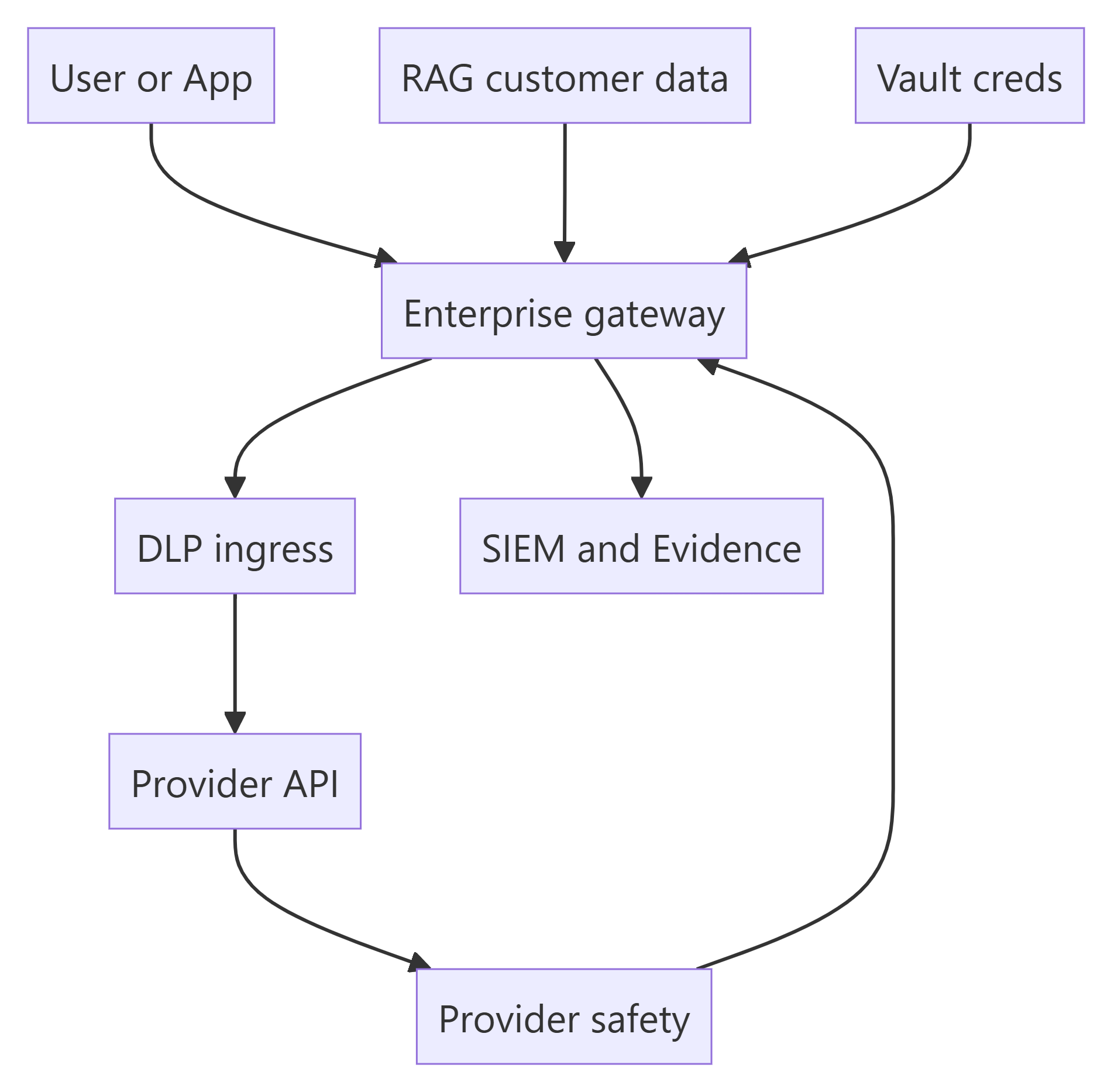
E.1.2 Managed AI API (Azure OpenAI, Amazon Bedrock, Google Vertex AI)
When to use: Provider hosts base model weights; customer controls prompts, RAG, gateway, keys, and logging.
| Area | Minimum controls | Control points | Guide |
|---|---|---|---|
| Identity | No long-lived keys in code; RBAC per deployment | 1, 3, 8 | Ch.2 managed AI, Appendix D |
| Configuration | Approved model/deployment ID, region, API version snapshot | 5, 8, 9 | Appendix D Evidence fields |
| Data boundary | DLP on prompt/response; RAG ACL | 4, 7, 10 | Ch.4, Ch.7 |
| Evidence | Cannot sign weights → config snapshot + test report | 9 | Ch.11 Evidence Pack |
Vendor notes (informative):
| Provider | Customer records in Evidence Pack |
|---|---|
| Azure OpenAI | Resource name, deployment name, API version, content-filter config hash |
| Amazon Bedrock | Model ID, guardrail ID/version, region, inference profile ARN |
| Google Vertex AI | Model resource path, region, safety settings snapshot |
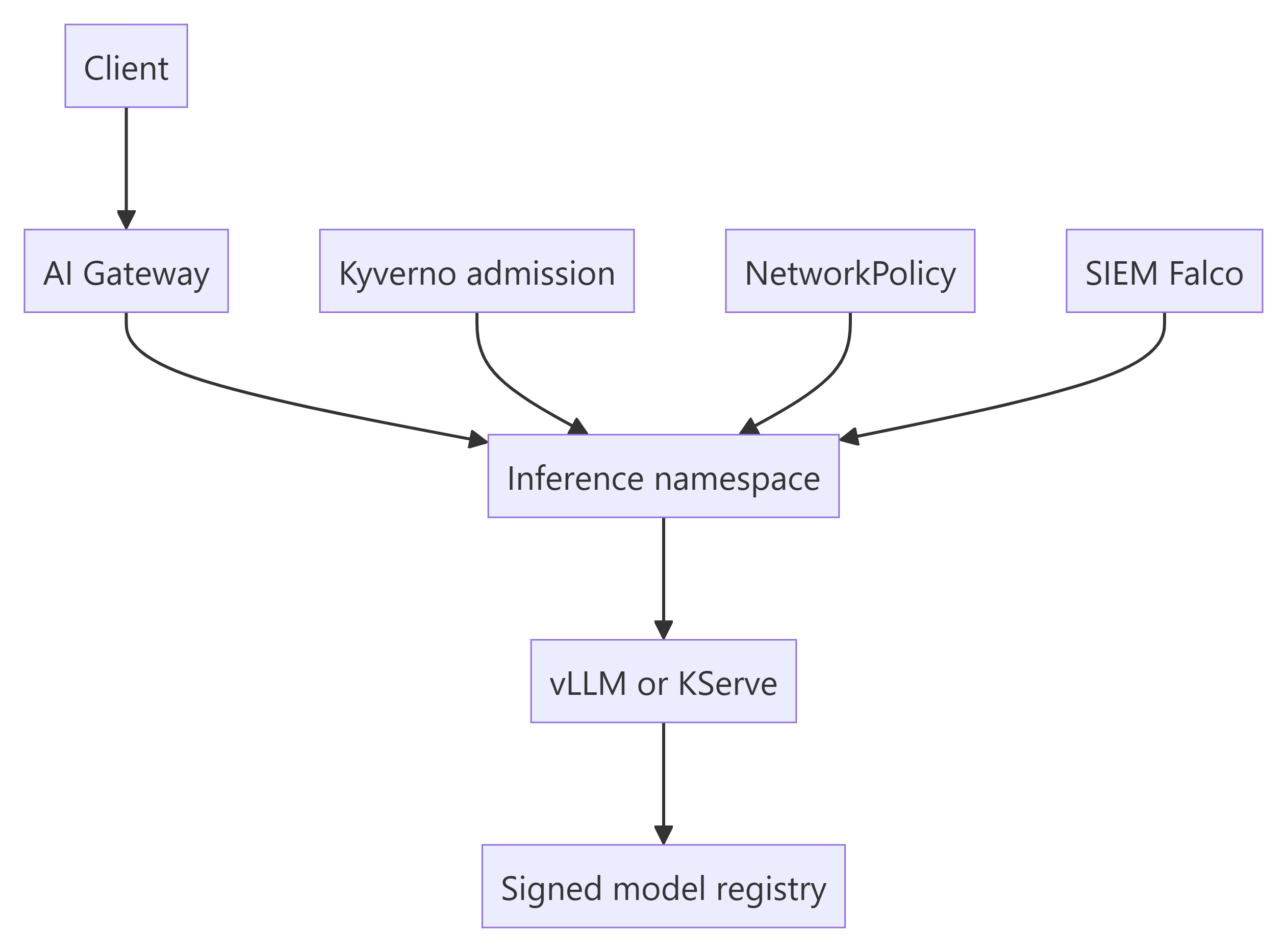
E.1.3 Self-hosted LLM (vLLM / KServe on Kubernetes)
When to use: Organization controls model weights, inference stack, and cluster.
| Area | Minimum controls | Control points | Guide |
|---|---|---|---|
| Supply chain | ModelScan, signing, verify before serve | 2, 3, 9 | Ch.5, Ch.16 |
| Cluster | Namespace isolation, NetworkPolicy, signed images | 3, 9, 10 | Ch.16 |
| Runtime | API key on inference, rate limits, egress allowlist | 10 | Ch.16 vLLM pattern |
| CT / retrain | Same lifecycle as initial release | 4, 7, 8, 9 | Ch.6 CT cycle |
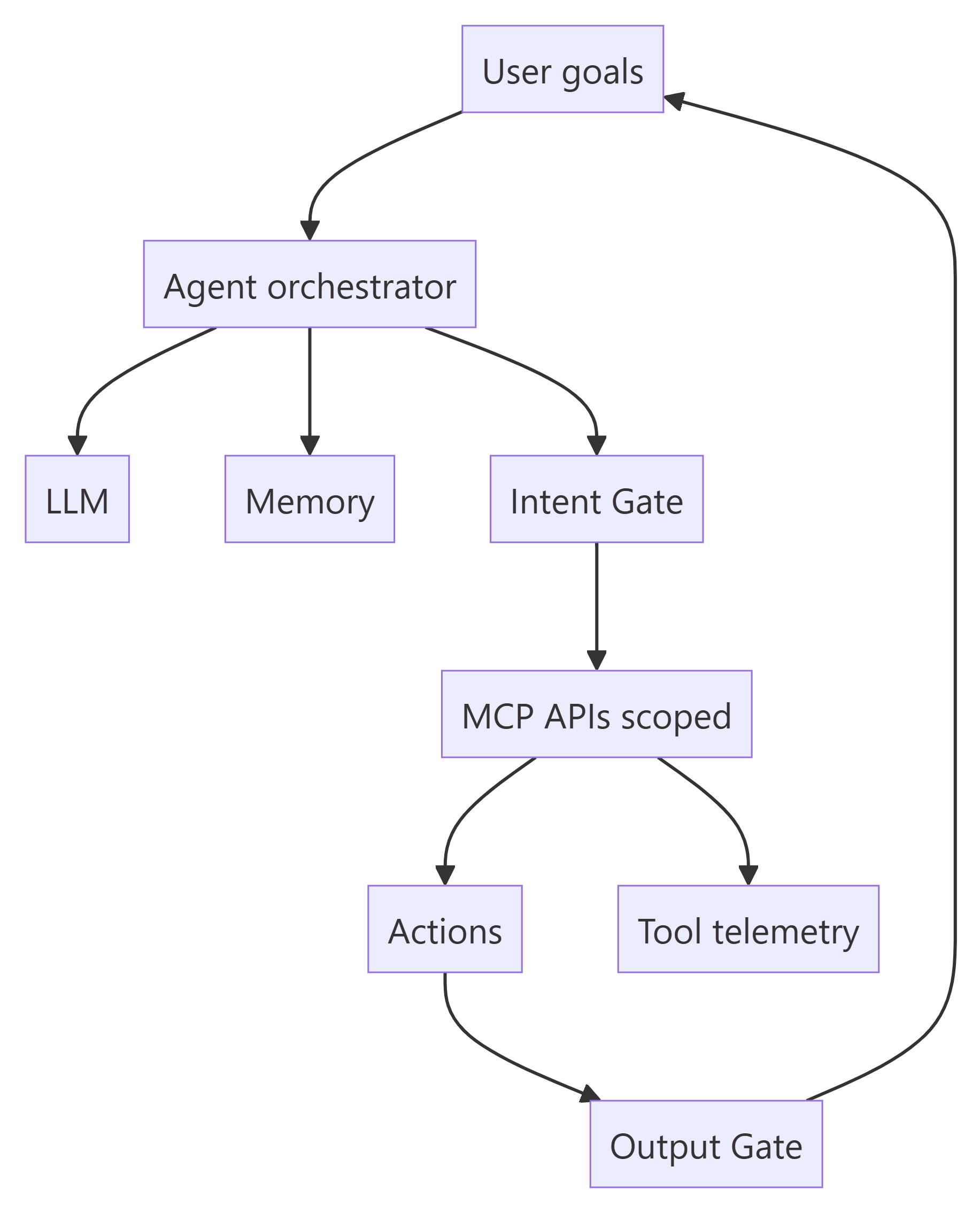
E.1.4 Agent with tools (MCP / APIs)
When to use: LLM can invoke tools, read files, or perform multi-step actions.
| Area | Minimum controls | Control points | Guide |
|---|---|---|---|
| Tools | Least privilege, allowlist, schema pin | 7, 10 | Ch.8, Ch.7 MCP |
| High-risk actions | HITL for financial/destructive operations | 7, 8 | Ch.8 Intent Gate |
| Memory | Sanitize on write, TTL, tenant isolation | 7, 10 | Ch.8 Memory Poisoning |
| MCP | Gateway, mcps-audit / Agent Scan, no shadow MCP |
3, 7 | Ch.7 MCP hardening |
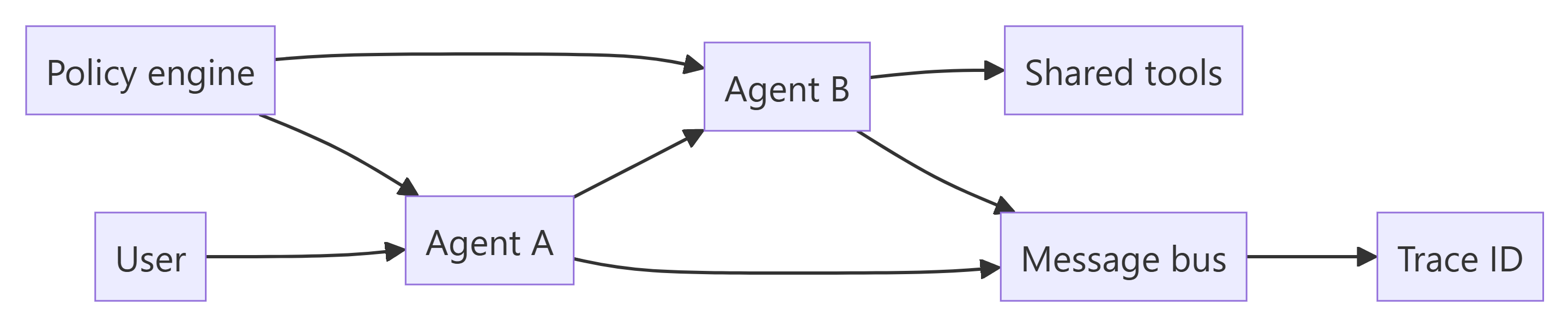
E.1.5 Multi-agent system
When to use: Multiple agents delegate tasks, share memory, or call each other.
| Area | Minimum controls | Control points | Guide |
|---|---|---|---|
| Delegation | Sub-agent cannot exceed parent tool scope | 7, 10 | Ch.8 Multi-Agent |
| Trust | Treat inter-agent messages as untrusted input | 7 | Ch.8 MAESTRO |
| Observability | Trace ID across agent chain | 10 | Ch.10 telemetry |
E.1.6 Classic ML (tabular / vision — no LLM)
When to use: Traditional training pipeline; no prompt/RAG/agent surface.
| Area | Minimum controls | Control points | Guide |
|---|---|---|---|
| Data | Lineage, PII, poison checks | 2, 4 | Ch.4 |
| Model | ModelScan, adversarial test for modality | 3, 7 | Ch.5 |
| Release | Sign artifacts, Evidence Pack | 8, 9 | Ch.6, Ch.11 |
References / Source mapping
Frameworks and standards - NIST AI RMF: Map (architecture-dependent controls); OWASP LLM Top 10 / ASI / MCP themes per card
Implementation guidance (this guide) - Architecture cards E.1.1–E.1.6 cross-link Chapters 2, 4–8, 10–11, 16, and Appendix D
Author practical guidance - Cards are fill-in operational patterns—not normative standard text.
E.2 Decision Matrix
Use this matrix to select mandatory control themes by architecture. Map each row to control points in Chapter 6 and evidence in E.4.
| If your primary architecture is… | You must prioritize… | Blocking release decisions at… | Integrity evidence at… | Start chapters |
|---|---|---|---|---|
| Managed AI API only | Gateway, DLP, config snapshot, Shadow AI policy | 4 (data in prompts/RAG), 7 (injection/leak tests), 8 | 9 (deployment ID, region, config hash—not weight signature) | Ch.2, 7, Appendix D |
| Enterprise RAG | Ingest ACL, retrieval ACL, reindex playbook, output gate | 4 (poisoned corpus), 7 (RAG leakage tests), 8 | 9 (index version hash + model/config evidence) | Ch.4, 7 |
| Self-hosted LLM | Model scan, signing, K8s isolation, admission verify | 4, 7, 8 | 9 (signature + attestation) | Ch.5, 6, 16 |
| Agent + MCP | Intent Gate, tool allowlist, MCP scan, HITL | 7 (tool misuse tests), 8 | 9 (agent config + tool manifest hash) | Ch.7, 8 |
| Multi-agent | Delegation policy, session trace, bus isolation | 7, 8 | 9 + inter-agent policy version | Ch.8, 10 |
| Classic ML | Data validation, adversarial test, signing | 4, 7, 8 | 9 (model signature) | Ch.4, 5, 6 |
Reference implementation flow (implementation-neutral):
Organizations often implement the lifecycle through existing delivery tooling. A typical pattern (not a mandated stack):
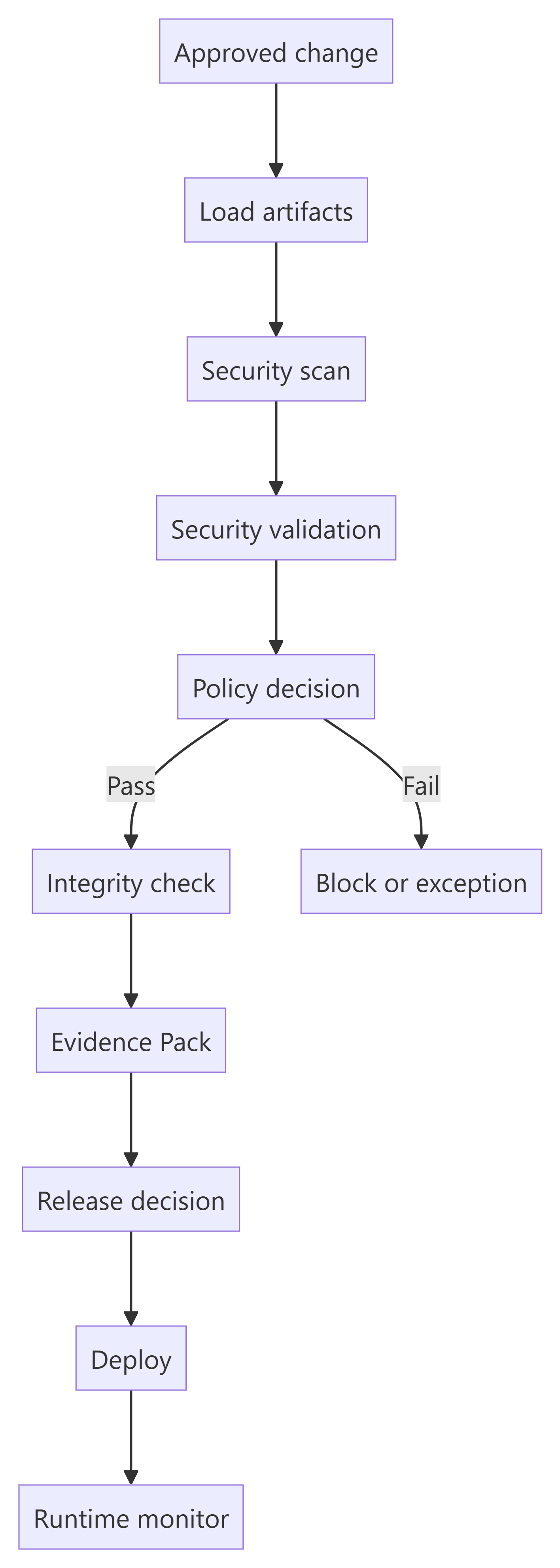
| Stage | Example capabilities (informative) | Control points |
|---|---|---|
| Change trigger | GitLab/GitHub merge, ticket, scheduled CT | 1 |
| Scan layer | Gitleaks, Trivy, ModelScan | 2, 3 |
| Security validation | Garak, Promptfoo, ART (by modality) | 7 |
| Policy decision | OPA/Conftest, GRC workflow | 4, 8 |
| Evidence Pack | JSON bundle, GRC record, registry metadata | 8, 9, 10 |
| Deploy | Canary, signed image verify, gateway policy version | 9, 10 |
This guide does not ship CI/CD templates. Implement and test flows in your environment. Tool examples: Chapter 12 appendix.
References / Source mapping
Frameworks and standards - OpenSSF MLSecOps whitepaper (2025): lifecycle stage mapping (informative)
Implementation guidance (this guide) - Lifecycle control points (Chapter 6); Release decision model (Chapter 6)
Author practical guidance - Decision matrix rows and example CI/CD stages are illustrative—mandatory themes vary by threat model.
E.3 Threat Model Template
Copy this table per system or architecture card. Replace placeholders. Output should feed control point criteria and Evidence Pack requirements (Chapter 2).
System: ____ Architecture card: ____ Date / version: ___
| Asset | Threat (STRIDE / OWASP / ATLAS ref) | Control (prevent / detect / respond) | Lifecycle control point(s) | Residual risk (accept / mitigate / transfer) | Evidence required |
|---|---|---|---|---|---|
| Training dataset | e.g. Data Poisoning, ML01 |
Validation, lineage, PII mask | 2, 3, 4 | Scan report, lineage ID | |
| Model weights | e.g. backdoor, unsigned swap | ModelScan, signing | 3, 7, 9 | Hash, signature verify log | |
| RAG index | e.g. Retrieval Poisoning |
Ingest ACL, reindex playbook | 4, 5, 7 | Index version hash | |
| Prompt / system instructions | e.g. LLM01 injection |
Gateway, guardrails, red team | 7, 10 | Test report URI | |
| Agent tools / MCP | e.g. ASI02, MCP09 |
Intent Gate, allowlist, scan | 3, 7, 10 | Tool manifest hash, scan PDF | |
| API keys / secrets | e.g. exposure in agent trace | Vault, proxy, rotation | 3, 10 | Secret scan clean, rotation log | |
| Inference endpoint | e.g. model theft, GPU abuse | AuthN/Z, rate limit, Falco | 10 | Access log sample | |
| Managed API config | e.g. wrong region/model ID | Config review, snapshot | 5, 8, 9 | config_snapshot_hash |
Release blockers (define explicitly):
- [ ] Unmasked PII in training or RAG ingest → block at control point 4
- [ ] Security validation below threat-model threshold → block at 7
- [ ] Policy/compliance review failed → block at 8
- [ ] Missing signature or config snapshot → block at 9
References / Source mapping
Frameworks and standards
- OWASP LLM Top 10 (LLM01); OWASP ML Top 10 (ML01, ML02); MITRE ATLAS technique IDs in table placeholders; STRIDE (informative)
Implementation guidance (this guide) - Expected output of threat modeling (Chapter 2); Lifecycle control points (Chapter 6)
Author practical guidance - Template table and release blockers are fill-in worksheets—not a certified threat-modeling method.
E.4 Evidence Pack Template
An Evidence Pack is an audit evidence pattern (Chapter 11). Use the structure below as a fill-in template (JSON, YAML, or GRC form). Field names are illustrative.
# Evidence Pack — template (informative; validate in your GRC/tooling)
evidence_pack:
  id: "ep-YYYY-MM-DD-<release-id>"
  system_name: ""
  architecture_card: ""  # e.g. enterprise-rag, managed-api, self-hosted-vllm
  release_version: ""
  control_point_8_approval:
    approver: ""
    decision: "approve | reject | risk_accept"
    timestamp: ""
    exception_id: ""  # if risk_accept

  data:
    dataset_version: ""
    lineage_uri: ""
    pii_scan_result: "pass | fail"
    sensitivity_class: ""

  model:
    model_id: ""
    artifact_hash: ""
    signature_verify: "pass | n/a-managed-api"
    ai_bom_uri: ""

  managed_api:  # omit if self-hosted
    provider: "azure-openai | bedrock | vertex"
    deployment_id: ""
    region: ""
    api_version: ""
    config_snapshot_hash: ""

  rag:  # omit if not applicable
    index_version_hash: ""
    source_allowlist_version: ""
    reindex_playbook_run: "yes | no"

  agent_mcp:  # omit if not applicable
    agent_config_hash: ""
    tool_allowlist_version: ""
    mcp_scan_report_uri: ""

  security_validation:
    report_uri: ""
    test_suite_hash: ""
    control_point_7_result: "pass | fail"

  supply_chain:
    sbom_uri: ""
    vulnerability_summary: ""

  policy:
    opa_bundle_version: ""
    gate_decisions: []

  deployment:
    environment: ""
    canary_result: ""
    rollback_plan_uri: ""

  runtime:
    gateway_policy_version: ""
    siem_feed_active: "yes | no"
Minimum sections for Level 1 maturity: data, security_validation, policy, release approval, and either model.signature_verify or managed_api.config_snapshot_hash.
References / Source mapping
Frameworks and standards - CycloneDX AI/ML BOM themes; NIST AI RMF: Measure (evidence and documentation)
Implementation guidance (this guide) - What is an Evidence Pack? (Chapter 11); Recommended Evidence Pack contents (Chapter 11); Appendix D Evidence fields (Chapter 15)
Author practical guidance - YAML field names and minimum sections are illustrative implementation patterns.
E.5 Operational Playbooks
Short runbooks for SOC and platform teams. Expand with your tooling, contacts, and SLAs (Chapter 10).
E.5.1 Runtime prompt injection (direct or indirect)
| Phase | Actions | Owner | Evidence |
|---|---|---|---|
| Detect | SIEM alert: guardrail block spike, jailbreak pattern, or user report | SOC | Alert ID, Prompt Trace |
| Contain | Tighten gateway rules; disable high-risk tools if agent involved; rate-limit source IP/session | Platform / SOC | Change ticket, policy version |
| Preserve | Snapshot prompt, response, model version, session/trace ID, retrieved context hash | SOC | Ch.10 first 30 min |
| Eradicate | If RAG indirect: remove/quarantine document, re-index; if model-specific: rollback to last signed release | ML / Platform | Reindex log, rollback record |
| Recover | Restore service with updated tests at control point 7; monitor false positive rate | ML / SOC | Updated test report in Evidence Pack |
| Lessons learned | Update threat model, detection rules, ingest allowlist; postmortem within SLA | Security | Postmortem URI in governance record |
E.5.2 RAG corpus contamination / retrieval poisoning
| Phase | Actions | Owner | Evidence |
|---|---|---|---|
| Detect | Abnormal answers citing unknown doc IDs; ingest anomaly; user report | SOC / ML | Retrieval log, document hash |
| Contain | Disable affected collection or tenant; stop ingest pipeline | Platform | Index isolation record |
| Preserve | Export poisoned document metadata, ingest audit trail, query logs | SOC | Evidence Pack runtime section |
| Eradicate | Delete poisoned objects; run Reindex Playbook; ACL review | ML Engineer | New index_version_hash |
| Recover | Regression prompt suite at control point 7; canary traffic | ML / Platform | Validation report |
| Lessons learned | Tighten ingest scan; update source allowlist | Security / Data | Updated threat model row |
E.5.3 Agent tool abuse / unauthorized action
| Phase | Actions | Owner | Evidence |
|---|---|---|---|
| Detect | Spike in sensitive tool calls; DLP hit; anomalous API egress | SOC | Tool Invocation Logs, trace ID |
| Contain | Disable tool or agent; invoke kill switch on API keys | Platform | Disable timestamp |
| Preserve | Full session trace, agent config version, tool argument logs | SOC | Ch.10 evidence table |
| Eradicate | Review Intent Gate policy; rotate secrets; patch tool scope | AppSec | Policy diff, rotation log |
| Recover | Re-enable with HITL for high-risk tools; red-team agent scenarios | ML / AppSec | Control point 7 agent tests |
| Lessons learned | Update tool allowlist; add SOC correlation rule | Security | Updated E.3 threat model |
References / Source mapping
Frameworks and standards - NIST AI RMF: Manage (incident response and recovery)
Implementation guidance (this guide) - Incident response (Chapter 10); First 30 minutes of an incident (Chapter 10); Reindex Playbook (Chapter 7)
Author practical guidance - Playbook phases and owners are starter runbooks—expand with your SLAs and tooling.
E.6 Master Control Matrix
Unified view: threat → prevent / detect / respond → lifecycle layer → control point → evidence. Detailed tool names: Chapter 12.
| Threat / attack | Prevent | Detect | Respond | Layer | Control point(s) | Evidence |
|---|---|---|---|---|---|---|
Data Poisoning |
Validation, lineage, ingest ACL | Drift, quality anomalies | Stop CT, quarantine dataset | Data | 2, 3, 4 | Scan report, lineage ID |
PII leakage |
Masking, DLP ingress/egress | DLP alerts, retrieval audit | Block output path, purge logs | Data / Runtime | 4, 10 | DLP log, mask proof |
| Poisoned model / pickle RCE | ModelScan, safe formats | Artifact scan in CI | Block promote, quarantine artifact | Model / Supply chain | 3, 7, 9 | ModelScan JSON, hash |
| Unsigned / swapped artifact | Signing, admission verify | Verify fail at deploy | Deny deploy, rollback | Supply chain | 9 | Signature log |
Prompt Injection |
Gateway, input limits | Guardrail blocks, SIEM rules | Contain session, tighten policy | Runtime | 7, 10 | Prompt trace, test report |
RAG / retrieval poisoning |
Ingest scan, ACL | Bad citation patterns | Reindex, isolate collection | RAG | 4, 5, 7 | Index hash, reindex log |
Tool Abuse / ASI02 |
Intent Gate, scoped IAM | Tool rate anomalies | Disable tool, HITL | Agent | 7, 10 | Tool logs, policy version |
MCP tool poisoning / MCP09 |
Allowlist, gateway, static scan | Schema rug-pull detection | Revoke server, re-consent | MCP | 3, 7 | mcps-audit report |
| Memory poisoning | Sanitize on write, TTL | Conversation drift | Clear memory store | Agent | 7, 10 | Memory purge record |
| Shadow AI | AI-AUP, CASB | Egress to consumer LLM | Block, user outreach | Governance | 1, 11 | AUP version, CASB alert |
| K8s / infra exposure | NetworkPolicy, RBAC | Falco, unsigned image deny | Isolate namespace | Infrastructure | 3, 10 | Admission denial log |
| Adversarial drift | Baseline prompts, canary | Session anomaly vs baseline | Stop auto-CT, manual review | Runtime | 7, 10 | Drift playbook ref |
References / Source mapping
Frameworks and standards
- OWASP LLM Top 10, OWASP ML Top 10, OWASP ASI (ASI02), OWASP MCP Top 10 (MCP09); MITRE ATLAS techniques referenced in Chapter 12
Implementation guidance (this guide) - Primary Mapping (Chapter 12); Lifecycle control points (Chapter 6)
Author practical guidance - Matrix consolidates guide guidance for gap analysis—it does not add new normative requirements.
Practical summary
- Pick an architecture card (E.1) and confirm rows in the decision matrix (E.2).
- Complete the threat model template (E.3) and define release blockers at control points 4, 7, 8, 9.
- Instantiate the Evidence Pack template (E.4) in your GRC or registry workflow.
- Wire playbooks (E.5) into SOC runbooks and on-call.
- Use the master control matrix (E.6) for design review and gap analysis against Chapter 12.
This appendix does not add new normative requirements beyond the lifecycle model in Chapter 6. It packages existing guidance for production implementation.