Chapter 16: Kubernetes Deployment Reference
Purpose
This chapter provides operational reference patterns for deploying and hardening ML/LLM inference on Kubernetes. It complements the multi-tenant controls in Chapter 7 and the lifecycle decision points in Chapter 6 with concrete cluster-level controls.
Scope: Cloud-native enterprise inference (vLLM, KServe, Triton, Ray Serve, custom gateways). Edge/IoT and confidential-GPU (TEE) patterns remain out of scope — see vendor docs and specialized frameworks.
No bundled artifacts: This guide ships markdown content only (no
examples/folder, no Kubernetes YAML, no CI/CD pipeline templates, no JSON schemas). Patterns below are architectural guidance. Implement and test IaC in your environment using maintained upstream references (vLLM production-stack, Kyverno policy samples, KServe docs).
References / Source mapping
Frameworks and standards
- Kubernetes Pod Security Standards; CNCF security TAG guidance
- OWASP LLM Top 10: deployment and supply-chain themes (LLM03, LLM05)
Implementation guidance (this guide) - Multi-tenant RAG (Chapter 7); Release decision model (Chapter 6)
Author practical guidance - Namespace layout and Kyverno policy names are illustrative patterns—validate against your cluster baseline.
Reference architecture
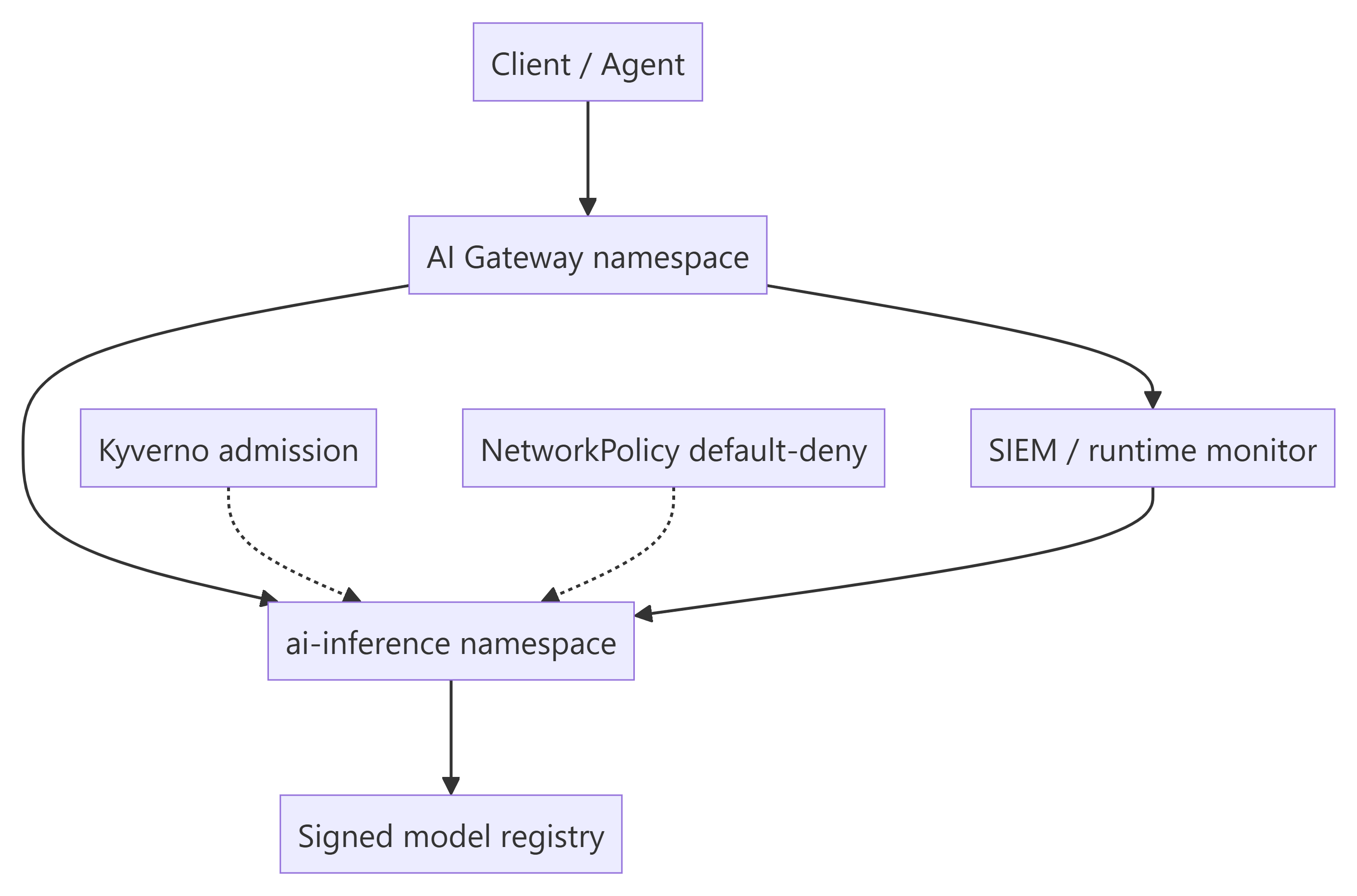
| Layer | Security objective | Example control |
|---|---|---|
| Edge | AuthN, rate limit, prompt policy | AI Gateway (Ch.7) |
| Namespace | Blast-radius isolation | Separate ai-inference, ai-gateway, ai-training |
| Admission | Unsigned image block | Kyverno verifyImages / ImageValidatingPolicy |
| Network | Lateral movement reduction | Default-deny + explicit egress allowlist |
| Workload | Least privilege | Restricted PSA, non-root, dropped caps, GPU node pools |
| Runtime | Attack detection | Falco/Tetragon rules for GPU abuse, cryptomining |
| Supply chain | Model integrity | Cosign verify at deploy + digest-pinned images |
References / Source mapping
Frameworks and standards - Kubernetes Pod Security Standards; CNCF security TAG — layered defense model
Implementation guidance (this guide) - Purpose (this chapter); Multi-tenant RAG (Chapter 7)
Prerequisites
| Requirement | Notes |
|---|---|
| Kubernetes 1.25+ | NetworkPolicy support required |
| CNI with policy enforcement | Calico, Cilium, or equivalent |
| Policy engine | Kyverno or OPA Gatekeeper |
| Signed images | Cosign/Sigstore keys configured in cluster |
| GPU operator (if applicable) | NVIDIA GPU Operator or cloud-managed GPU nodes |
References / Source mapping
Frameworks and standards - Kubernetes NetworkPolicy (1.25+ baseline)
Implementation guidance (this guide) - Reference architecture (this chapter)
Author practical guidance - Version and CNI requirements are minimum bars—validate against your platform team's cluster standard.
Namespace isolation and RBAC
Treat training, inference, gateway, and observability as separate trust zones. Production inference namespaces should:
- Use Pod Security Admission
restricted(or your org equivalent). - Run workloads under dedicated ServiceAccounts with no cluster-admin bindings.
- Deny
automountServiceAccountTokenunless a sidecar truly needs API access. - Separate staging and production namespaces with different registry paths and signing keys.
Upstream references: Kubernetes Pod Security Standards, Kubernetes RBAC.
| Anti-pattern | Correct alternative |
|---|---|
Single default namespace for ML workloads |
Dedicated namespaces per lifecycle stage |
| Inference SA with secret write access | Read-only SA; secrets via External Secrets Operator |
| Shared cluster-admin for data scientists | Namespace-scoped RBAC + break-glass audit |
References / Source mapping
Frameworks and standards - Kubernetes Pod Security Standards; Kubernetes RBAC
Implementation guidance (this guide) - Cloud Native and Multi-Tenant deployment (Chapter 7)
Network policy — default deny
AI inference pods should not have unrestricted egress. Agentic workloads especially may call unpredictable external APIs at runtime; visibility + allowlist beats pretending you can predict every destination at deploy time (Application Security Standards playbook on AI egress).
Recommended pattern:
- Default-deny all ingress and egress in the inference namespace.
- Allow ingress only from the AI gateway namespace/pod label.
- Allow egress explicitly to: DNS, internal vector DB, observability collector, and approved external APIs (via egress gateway if possible).
- Log outbound requests at the gateway or egress proxy for SOC correlation (Ch.10).
Upstream references: Kubernetes NetworkPolicy, Cilium network policy guide.
For service mesh deployments, complement NetworkPolicy with Istio/Linkerd authorization policies (mTLS + L7 rules) as described in Ch.7 multi-tenant table.
References / Source mapping
Frameworks and standards - Kubernetes NetworkPolicy; Cilium network policy guide; Application Security Standards — AI egress playbook
Implementation guidance (this guide) - Advanced Multi-Tenant hardening (Chapter 7); SOC integration (Chapter 10)
Admission control — verify signed images
Unsigned or tampered container/model images must not schedule in production inference namespaces. Align this control with control point 9 (Integrity and Provenance) and registry promotion policy (Ch.5).
Kyverno can enforce cosign signatures at admission. OWASP/OpenSSF supply-chain practice maps to:
- Signature verify — image signed with org key or keyless GitHub OIDC
- Optional attestations — SLSA provenance, SBOM (CycloneDX), custom model-provenance type
Upstream references: Kyverno verifyImages (Sigstore/Cosign), Kyverno policy library — verify-image.
For Kyverno 1.18+, consider migrating to ImageValidatingPolicy for clearer audit reports and named verification stages (signature → attestation → digest mutation).
Admission behavior: Pod create → verify fail → Deny. Record denial events in Evidence Pack policy section.
References / Source mapping
Frameworks and standards - Kyverno verifyImages (Sigstore/Cosign); Kyverno ImageValidatingPolicy; OpenSSF SLSA / Sigstore supply-chain practice
Implementation guidance (this guide) - Provenance and signing (Chapter 5); Lifecycle control point 9 (Chapter 6)
vLLM on Kubernetes — secure deployment pattern
The vLLM production-stack project documents Helm-based deployment with API key protection:
| Control | Implementation |
|---|---|
| API authentication | vllmApiKey in Helm values → VLLM_API_KEY env; router validates Bearer tokens |
| Multi-tenant keys | Comma-separated key list supported natively by vLLM; production-stack router enforces allowlist (PR #937) |
| HF model access | HF_TOKEN from Kubernetes Secret, not plain values in git |
| Health checks | /health endpoint for liveness/readiness |
Reference tutorial: production-stack/tutorials/11-secure-vllm-serve.md
# Minimal pattern (adapt from production-stack values-11-secure-vllm.yaml)
servingEngineSpec:
  vllmApiKey:
    secretName: inference-api-key
    secretKey: VLLM_API_KEY
  modelSpec:
    - name: llama3
      repository: vllm/vllm-openai
      tag: latest   # Prefer digest pin in production: image@sha256:...
      modelURL: meta-llama/Llama-3.1-8B-Instruct
      requestGPU: 1
MLSecOps checklist for vLLM:
- [ ] Image digest-pinned and cosign-verified before deploy
- [ ]
VLLM_API_KEYper tenant or per environment (not shared prod/staging) - [ ] No public LoadBalancer without gateway/WAF in front
- [ ] GPU memory sanitization considered after CVE-class issues (see LeftoverLocals, Ch.13)
- [ ] Router + engine NetworkPolicy restricts who can reach port 8000
Upstream reference: vLLM production-stack — secure vLLM serve tutorial and Helm values in that tutorial — adapt and test in your cluster.
References / Source mapping
Frameworks and standards - vLLM production-stack; PR #937 — multi-tenant API keys
Implementation guidance (this guide) - LeftoverLocals case study (Chapter 13); GPU isolation (this chapter)
Author practical guidance - Helm snippet is illustrative—pin image digests and test in non-production before promotion.
KServe and generic model serving
KServe is a common Kubernetes model-serving layer. MLSecOps controls apply regardless of framework:
| Control | KServe / generic application |
|---|---|
| AuthN/Z | Istio/Knative authorization, OAuth2 proxy, or external AI gateway |
| Model storage | Signed OCI artifacts or signed PVC snapshots; verify before Predictor rollout |
| Autoscaling | HPA on GPU workloads — monitor for compute hijacking (Ch.3, Ch.10) |
| Canary / shadow | KServe canary traffic split — align with Ch.6 CT cycle controls |
Do not expose InferenceService directly to the internet without gateway guardrails.
References / Source mapping
Frameworks and standards - KServe project documentation
Implementation guidance (this guide) - Secure deployment methods for retrained models (Chapter 6); AI Compute Hijacking (Chapter 3)
GPU isolation and shared inference
GPU-related incidents (LeftoverLocals CVE-2023-4969, cryptomining on compromised Ray/vLLM clusters) show that software time-slicing alone is insufficient for sensitive multi-tenant tiers.
| Risk | Control |
|---|---|
| Cross-process GPU memory leak | Driver updates, memory sanitization, process isolation (Ch.13) |
KV Cache leak between tenants |
Tenant-partitioned cache; session cleanup; no shared sticky cache keys |
| GPU colocation side channels | NVIDIA MIG or dedicated GPU per tenant tier |
| Unauthorized GPU workloads | Node taints (nvidia.com/gpu), quota, Falco rules on unexpected GPU processes |
| Cryptomining | Runtime monitor + anomaly on GPU util vs expected inference baseline |
Inference security observability should capture serving-behavior signals (handler baselines, accelerator usage anomalies), not only model quality metrics (ARMO inference observability analysis).
References / Source mapping
Frameworks and standards - CVE-2023-4969 (LeftoverLocals); NVIDIA MIG documentation (vendor)
Implementation guidance (this guide) - LeftoverLocals case study (Chapter 13); Security metrics (Chapter 10)
Runtime security on the cluster
| Tool | Role in MLSecOps |
|---|---|
| Falco | Detect shell spawn in inference pods, unexpected outbound connections, crypto miners |
| Tetragon/eBPF | Fine-grained process and network observability |
| KubeArmor | Enforcement + audit for ML pod hardening |
| Cilium Hubble | Flow visibility for NetworkPolicy debugging and threat hunting |
Map runtime alerts to MITRE ATLAS techniques in SOC playbooks (Ch.10).
References / Source mapping
Frameworks and standards - MITRE ATLAS: runtime and infrastructure techniques (map in SOC playbooks) - Falco, Tetragon/eBPF, KubeArmor, Cilium Hubble — upstream project docs
Implementation guidance (this guide) - Detection Engineering (Chapter 10); Threat analysis with MITRE ATLAS (Chapter 10)
Egress control for agentic workloads
When agents run inside the cluster and generate outbound traffic dynamically:
- Deploy an egress gateway (Envoy/Squid) with domain allowlist + full request logging.
- Deny direct internet egress from agent executor pods.
- Require human approval (
Intent Gate, Ch.8) before adding new egress destinations. - Correlate egress logs with prompt/tool telemetry in SIEM.
References / Source mapping
Frameworks and standards - Application Security Standards — AI egress playbook
Implementation guidance (this guide) - Intent Gate (Chapter 8); Data required for telemetry (Chapter 10)
MCP servers on Kubernetes
When MCP tool servers run as cluster workloads (sidecars or standalone Deployments), apply the same isolation model as inference services plus MCP-specific controls from Chapter 7:
| Risk | Control |
|---|---|
| MCP server with ClusterRole | Dedicated namespace; no cluster-admin; RBAC scoped to required API only |
| Unsigned MCP image | Kyverno cosign verify (same as inference) |
| Tool schema rug-pull at runtime | Sidecar MCP gateway with hash-pinned tools/list; log schema changes to SIEM |
| Shadow MCP sidecar | Admission deny for unregistered MCP container names; allowlist in Kyverno |
| Egress from MCP pod | Default-deny NetworkPolicy; route tool HTTP via egress gateway |
Pair cluster manifests with an MCP server source review such as mcps-audit before deploy (Ch.12).
References / Source mapping
Frameworks and standards
- OWASP MCP Top 10: MCP03, MCP09
Implementation guidance (this guide) - Model Context Protocol (MCP) security (Chapter 7); Appendix: Informative tool command reference (Chapter 12)
Mapping to lifecycle control points
| Lifecycle control point | Kubernetes control |
|---|---|
| 3 — Security and quality review | Scan IaC for cluster manifests; scan inference images |
| 8 — Release decision | Policy review: NetworkPolicy + Kyverno + PSA level documented |
| 9 — Integrity and provenance | Cosign sign image/model artifact where applicable; Kyverno verify at admission |
| 10 — Store and monitor | Deploy signed digest; enable runtime + GPU telemetry to SOC |
References / Source mapping
Frameworks and standards - OpenSSF MLSecOps whitepaper (2025): deploy/monitor lifecycle alignment
Implementation guidance (this guide) - Lifecycle control points (Chapter 6); What is an Evidence Pack? (Chapter 11)
Tool and reference index
| Resource | URL |
|---|---|
| vLLM production-stack | https://github.com/vllm-project/production-stack |
| KServe | https://github.com/kserve/kserve |
| Kyverno image verification | https://kyverno.io/docs/policy-types/image-validating-policy/ |
| awesome-MLSecOps (community index) | https://github.com/RiccardoBiosas/awesome-MLSecOps |
| OpenSSF Secure MLOps whitepaper | https://openssf.org/wp-content/uploads/2025/08/OpenSSF_MLSecOps_Whitepaper.pdf |
| KubeStellar Console (multi-cluster MLSecOps dashboard) | https://github.com/kubestellar/console |
References / Source mapping
Frameworks and standards - Upstream URLs in table (vLLM, KServe, Kyverno, OpenSSF whitepaper)
Implementation guidance (this guide) - Commercial Tool Market Map (Chapter 12) for broader tooling context
Author practical guidance - Tool index is informative—no endorsement; evaluate fit against your threat model.
Minimum baseline checklist (Level 2 production)
- [ ] Dedicated namespaces with restricted PSA for inference
- [ ] Default-deny NetworkPolicy + gateway-only ingress
- [ ] Kyverno (or OPA) blocks unsigned images in prod namespaces
- [ ] Inference pods: non-root, dropped capabilities, secrets from External Secrets/Vault
- [ ] vLLM/KServe protected by API key or OAuth at gateway
- [ ] GPU isolation strategy documented (MIG or dedicated nodes for sensitive tenants)
- [ ] Runtime rules for GPU abuse and cryptomining enabled
- [ ] Deploy only digest-pinned, signed images tied to Evidence Pack
References / Source mapping
Frameworks and standards - Kubernetes Pod Security Standards; Kyverno cosign verification
Implementation guidance (this guide) - Level 2: Operational (Chapter 14); Minimum baseline checklist items above
Practical principle
Kubernetes secures where the model runs; MLSecOps secures what runs and whether it may be promoted. Cluster hardening without lifecycle integrity controls and release decisions is incomplete — and signed models deployed in wide-open namespaces are equally unsafe.
References / Source mapping
Frameworks and standards - OpenSSF MLSecOps whitepaper (2025): infrastructure + lifecycle integration
Implementation guidance (this guide) - Release decision model (Chapter 6); Reference architecture (this chapter)
Author practical guidance - Where/what/whether framing is author synthesis for platform + AppSec alignment.
Practical summary
- Isolate inference in dedicated namespaces with least-privilege RBAC.
- Default-deny network traffic; expose inference only through an AI gateway.
- Enforce cosign verification at admission for production namespaces.
- For vLLM, use production-stack patterns for API keys and secrets — never commit keys to git.
- Treat GPU memory and shared inference as a first-class threat (LeftoverLocals, KV cache).
- Pair cluster controls with Evidence Pack records for every promoted artifact.
References / Source mapping
Implementation guidance (this guide) - E.1.3 Self-hosted LLM architecture card (Chapter 17); sections above in this chapter